Explore ideas
Find practical ideas by the challenge you're trying to solve.
Filter by what you're trying to achieve, who you're trying to reach, where it happened and how much evidence is available. Every article separates activity from evidence and ends with what you could test and measure.
Get new cinema ideas, practical case studies and evidence updates in your inbox.
Searches titles, summaries, cinema and organisation names, initiatives, topics and countries — not full article text. Accents are ignored and a few common alternatives are included (for example loyalty and membership, F&B and food and beverage).
50 results
Sorted by most recent
Each card carries an evidence label. What this means

Build the next visit into a free youth screening
A free monthly youth screening is followed by a discount code for a return visit. The practical question is how to turn a first encounter into a second booking.

Make a regular screening slot easy for families to remember
Alliance Française de Bangui advertises sixteen Saturday screenings from 10 October to 28 November 2026: Kété Ciné for children at 14:00 and an adult session at 16:00, in partnership with IFcinéma.

Give a local documentary a coordinated journey across cinemas
Chile’s Red de Salas de Cine coordinates screenings of the documentary “Vuelvo donde nunca estuve” across member cinemas from 8 October 2026, with filmmaker or participant discussions at selected venues.

Use a short membership and guest ticket to encourage trial
Croydon Film Society, which screens at Metro Cinemas Boronia, sells a three-month October–December 2026 membership covering five films, with newsletters, a programme poster and a guest ticket.

Give local exhibitors a shared audience-development campaign
access>CINEMA’s New Audience Initiative supports one film a quarter with a central marketing kit, tailored social assets and local marketing funding that participating venues can apply for.

Let young audiences programme and host a cinema circuit
Students help create and host a season across ten independent cinemas, combining films with opportunities to meet, take part and learn.

Make unfamiliar films feel less risky for members
Palace’s member guarantee allows a refund request within the first 30 minutes. Clear eligibility and a simple staff process are central to the idea.

Make upcoming films an audience event of their own
Warehouse Cinemas reports 845 attendees across its circuit at its third annual Trailer Fest in 2026. The transferable idea is an audience occasion built around upcoming films; later ticket sales and commercial returns are not established.

Give an independent film community a home inside a multiplex
Singapore Film Society describes SFS Somerset as a 66-seat cinema in Golden Village Cineleisure, opened on 1 January 2026. Its recurring membership combines selected free screenings with a S$6 discount on SFS Somerset tickets.

Test a route from film discovery to community exhibition
WiC, introduced at Durban FilmMart, proposes to connect film discovery, ticket acquisition, venues and audience intelligence for African cinema. It is an announced proposition with a narrower near-term rollout, but it raises a useful question: can interest in a film be carried through to a local paid screening?

Give a repertory season a daily reason to return
Regal's 31 Screams on Screen runs from 1 to 31 October 2026 with a different classic horror selection each day, advertised at $7.99, plus child-friendly weekend choices. A short, clearly scheduled season can turn one genre interest into several separate visit decisions.

Match a morning cinema offer to local school holidays
CinemaxX advertises €5 tickets for screenings that start before 12:30 during each participating location's autumn school holidays. The useful design is the combination of a clear daypart with each catchment's own holiday calendar.

Make the film continue at the tasting table
São Paulo Food Film Fest's fifth edition paired more than 40 films with talks, classes and post-screening tastings. Admission was free and tasting access used a retained cinema ticket; no ticket-yield or concession uplift is reported.

Make the audience part of a recurring cinema comedy night
Ster-Kinekor's listing describes a weekly 90-minute live comedy contest at The Zone @ Rosebank, where audience applause determines the winner. Current dates, ticket prices and outcomes are not established.

Make film discussion part of the membership offer
QFT's free, bookable After the Credits group gives eligible members a monthly place to discuss four films and volunteer to chair. The inspected September session is past; participation and retention outcomes are not reported.

Pair each film in a short programme with a conversation
Cinema Akil's BLACKBIRD, 25–27 September 2026 in Dubai, was a three-day curated programme in which each film was followed by an online Q&A or an open community conversation. The programme design is documented; audience and commercial outcomes are not reported.
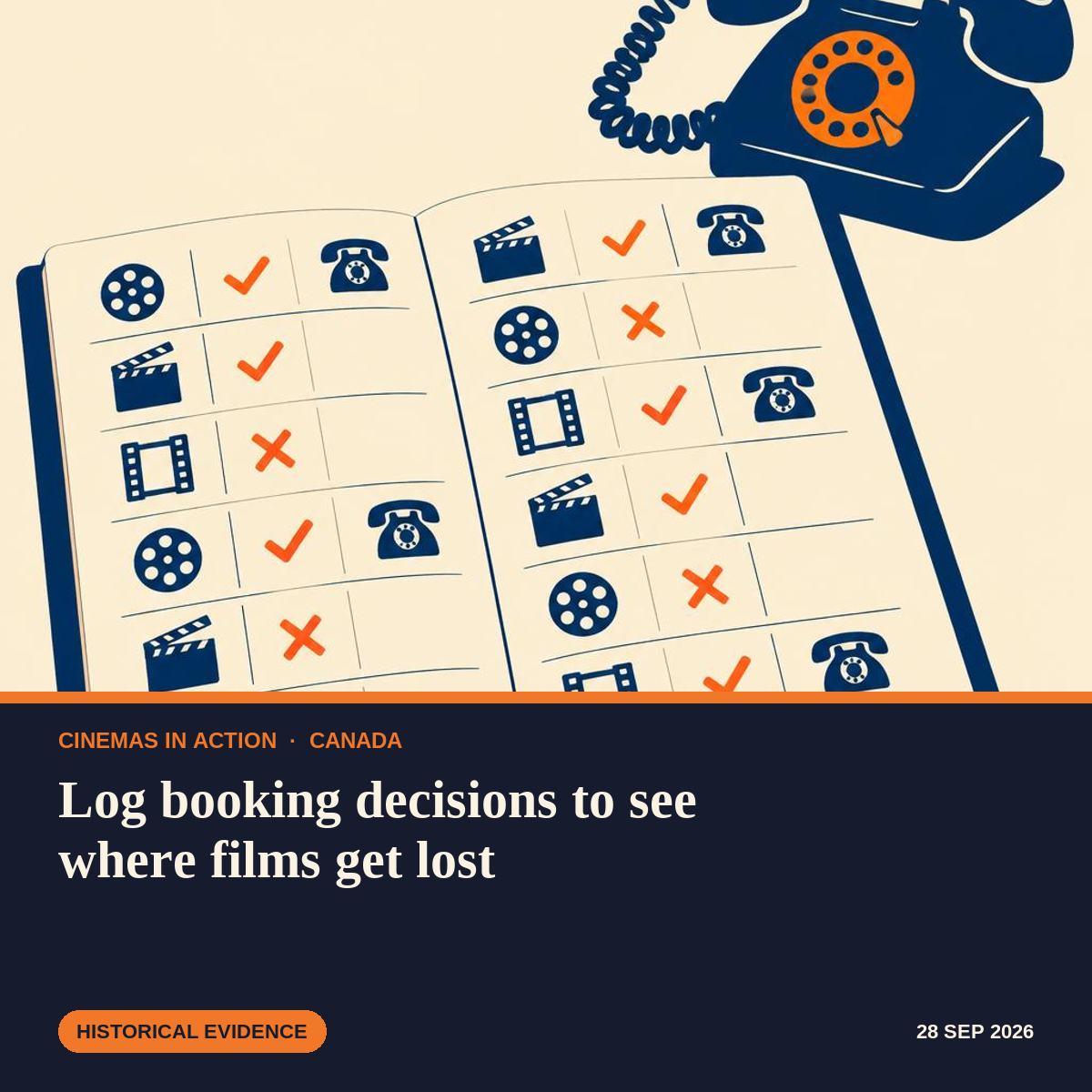
Log booking decisions to see where films get lost
NICE's Ontario study logged 238 booking decisions on Canadian films. Where a distributor made contact, 19 of 59 decisions ended in a booking (32%), against 7 of 137 without outreach (5%) — an association, not proof of cause.

Programme free themed film clubs with discussion
Cairo's Qasr El Cinema, part of Egypt's General Authority for Cultural Palaces, runs free themed film clubs at 8pm — world, European, Asian, classic, animation and novel-to-film strands — some followed by critics' discussions.

Give young audiences roles as viewers, jurors and filmmakers
Cinemagic's 37th festival for young people in Belfast combines family and teen screenings, age-banded CineSeeker juries, a Young Filmmaker Competition and workshops for 16–25-year-olds.
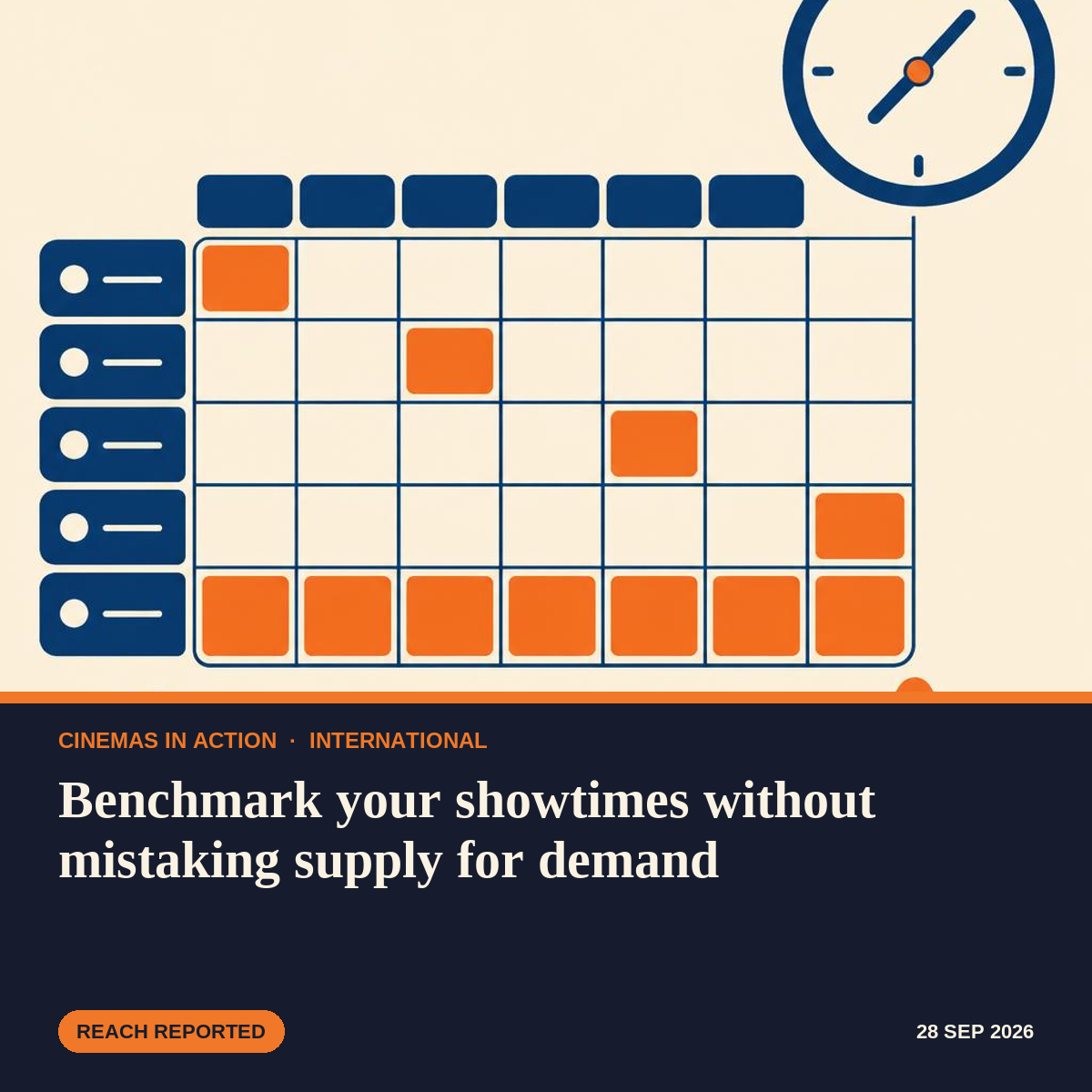
Benchmark your showtimes without mistaking supply for demand
FilmGrail analysed 6,163 public showtimes at 140 independent cinemas for 24–30 September 2026. It describes what cinemas offered, not what audiences chose, and the sample leans heavily to North America and one booking platform.

Design a film event around participation, then verify the record
Update 28 September 2026: Guinness World Records' official 'Largest attendance at a film screening' page records 51,258 people who attended Black Market from start to finish in Lagos on 26 September 2026. Media reported about 64,000 total event attendance, a separate, looser figure.
Build a community film festival around shared meals
Anfield People’s Cinema scheduled six pay-what-you-can screenings across five Liverpool community venues from 24–27 September 2026, with free meals and optional donations.

Share resources across an arthouse cinema network
European Arthouse Cinema Day shows how a network can supply multilingual creative, filmmaker participation, webinars and localisable formats while cinemas retain local programming choices.
Share infrastructure across volunteer-led film festivals
Free Film Festivals provides a shared identity and support model for independently organised, volunteer-led local festivals offering free screenings in community venues.

Connect environmental programming to local action
Chichester’s A Greener Screen activity connects films with local groups, talks and age-specific workshops. The programme design is visible, but no attendance or behaviour-change results are published.
Make festival participation more than a ballot
San Sebastián combines audience voting with civic-access invitations, creating more than one route into festival participation. No participation or conversion outcomes are published yet.
Make small cinemas part of a national cultural programme
The Korean Film Council’s Small Cinema Collection uses a national free programme to support local cinema activity. It shows a distribution model, but costs, attendance and venue-level effects are unavailable.
Give audiences more control of sensory screenings
Sensinema frames accessible cinema as an experience with greater audience control over sensory conditions. The event design is visible; attendance, satisfaction and repeat behaviour are not.
Test idle screens with a neutral programmer
Regal/Cineworld, IFTA and CNC announced a pilot using a neutral programmer to place films into otherwise-idle screen capacity. It is an observed test design with no published results yet.
Turn audience votes into paid demand tests
CGV’s COD-7 programme invites audiences to vote for titles, then moves selected films toward booking. The useful step is converting preference into paid demand rather than treating a vote as proof of attendance.
Schools are capacity management, not just audience development
Event Cinemas sells school screenings as a defined product: weekdays before 4pm, a published minimum group size, a fixed confirmation window, prepayment and an optional per-student food and drink package. The rules are the product, and they turn empty daytime capacity into a predictable booking.
A national cinema price event can still protect premium value
Brazil's Semana do Cinema runs from 10 to 16 September 2026 with a single headline price. Cinépolis and Cinemark both take part, and both publish their own fences around formats, seats and dayparts. The campaign is national; the margin decisions are local.
A festival should not disappear for eleven months
Watch Africa pairs an annual African film festival in Wales with monthly screenings and a free members' club. The point is not the extra screenings. It is that the audience, the partners and the mailing list stay warm, so each edition starts from a community rather than from zero.
Kinepolis turns coming-soon trailers into an interactive cinema event
Since 2019 Kinepolis has sold tickets to a trailer show. Audiences rate each forthcoming film on their phones, the ticket money goes to charity, and the circuit ends the evening with a declared preference attached to an identified customer.
A festival does not have to end when the festival ends
Cinema Rediscovered spends months securing prints, rights and context for a five-day festival in Bristol, then sends the result out as a touring package other cinemas can book. The 2025 festival drew 5,331 ticketed admissions and its touring programme added over 8,000 more across 50-plus partner venues.
A capped family offer is a test design worth copying
A summer children's price at a single Japanese cinema was set at 500 yen and capped at 10,000 redemptions. The value here is the structure of the test — defined audience, one simple price, a public cap, a short window and measurable redemption — not any proven commercial result.
School screenings are a product, not just a group discount
Village Cine School packages film selection, teacher guides, booking administration, price and post-film discussion time. The discount is the least interesting part of the offer.
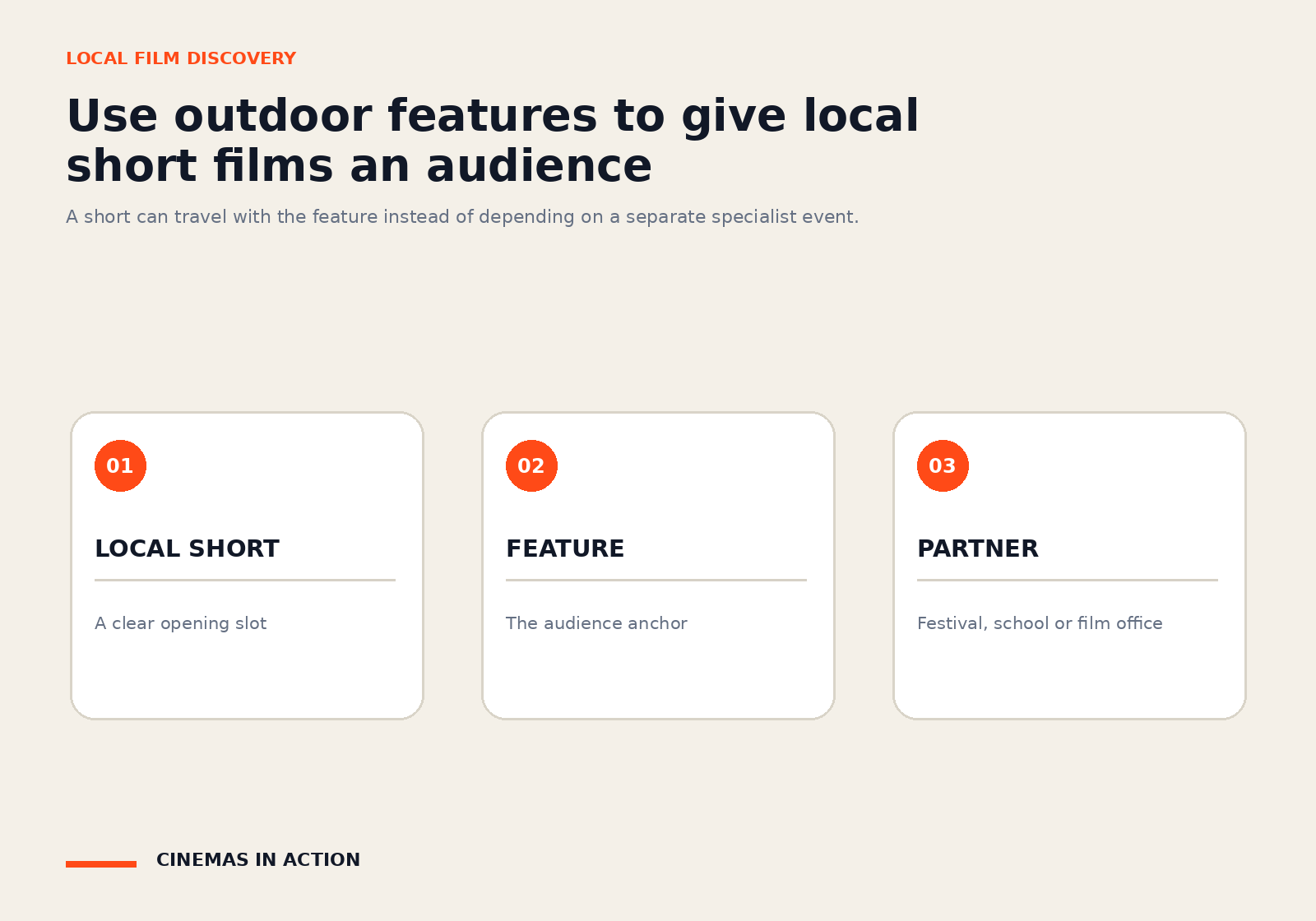
Use outdoor features to give local short films an audience
Palma’s free outdoor season pairs several feature films with shorts by emerging Balearic filmmakers, placing local work in front of a larger general audience.
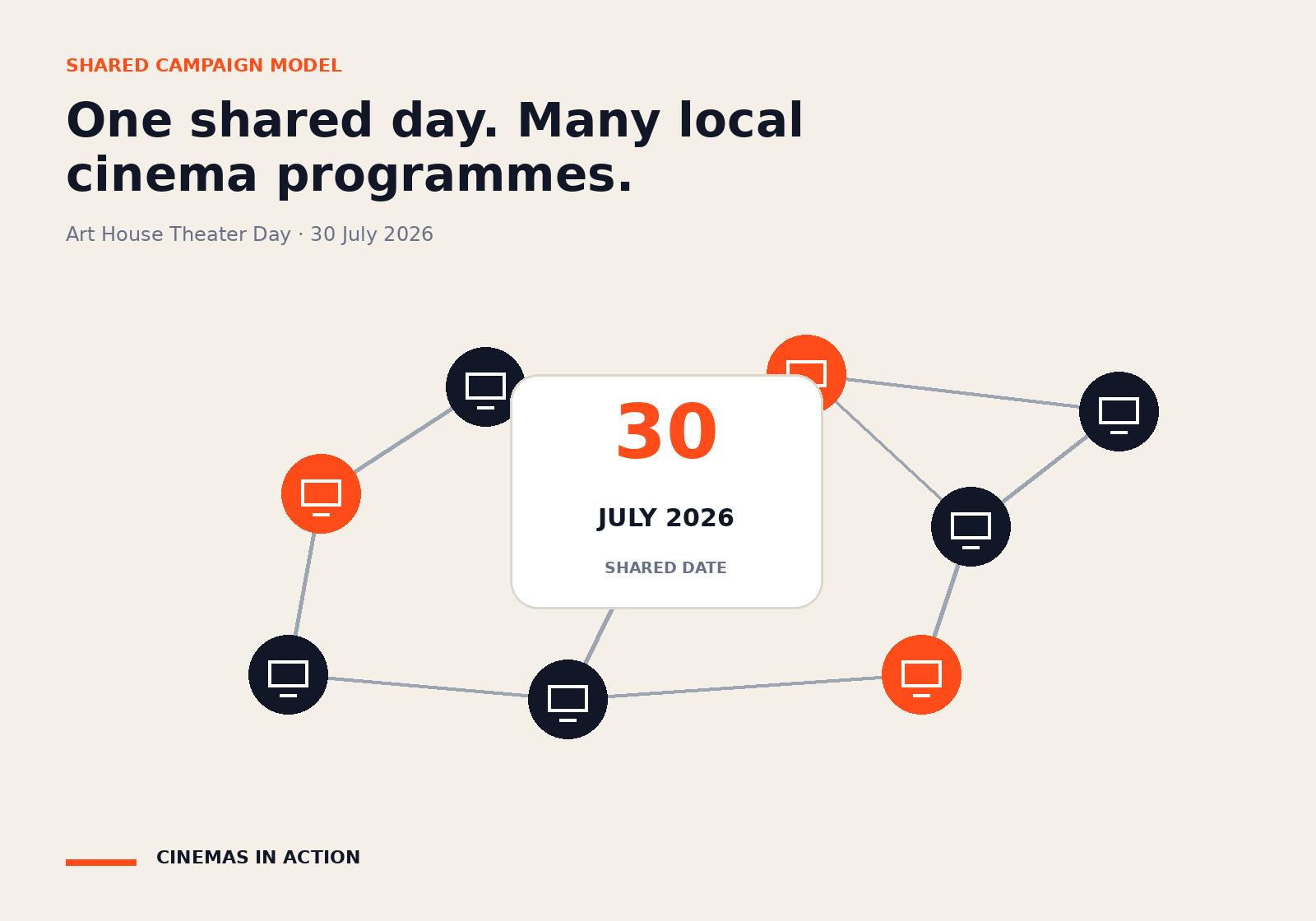
Create a shared cinema day without losing local identity
Art House Theater Day gives participating cinemas a common date, film slate, campaign identity, map, ambassador and additional materials while leaving local delivery with each venue. The 2026 event is scheduled for 30 July, so current results are not yet available.
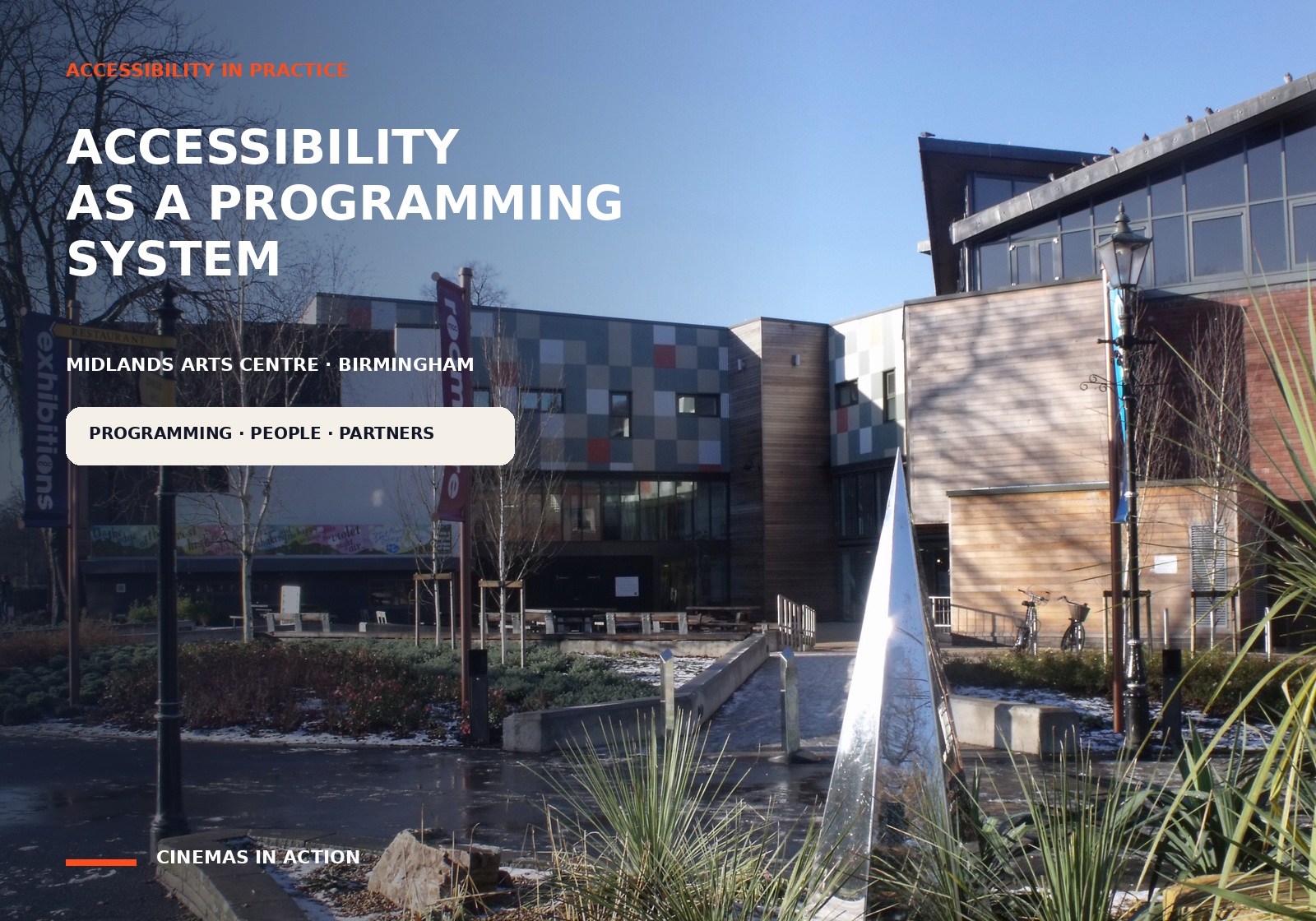
Build accessibility into the cinema programme, not around it
Midlands Arts Centre’s Expanding the Frame project treated accessibility as a programming, audience-development and organisational system. The published case study reports attendance above its year-three estimate, while leaving cost, revenue and long-term retention questions open.
Make open-caption screenings easier to find with a weekly rhythm
Amherst Cinema's named weekly caption rhythm is joined by Harkins' recurring Wednesday and Saturday 4pm model at selected locations. Both show how stable labels and access pages reduce discovery work; neither reports attendance uplift.
Build a specialist film premiere with a relevant local partner
Cameo Cinema combined a documentary premiere with a themed tasting, director conversation, live podcast and signed poster, creating an occasion that could not be replicated at home.
How to evaluate a dementia-friendly cinema pilot
Auckland’s three-cinema project shows how co-design, partner outreach, operational adjustments and shared evaluation can turn a small accessibility pilot into useful evidence.
What a Paris independent learned from testing an unlimited youth cinema pass
Cinéma des Cinéastes still offers a €15, 31-day pass for 15–25-year-olds. Its detailed 2016–17 pilot report shows what drove purchase, how people used it and where the economics became difficult, but it does not show how the current offer performs.
What it takes to embed accessibility into cinema programming
MAC Birmingham’s three-year Expanding the Frame programme treated access as a combination of programming, communication, technology, staff practice and audience dialogue.
Four ways cinemas structure family value
A comparison of prepaid passports, fixed-price mornings, bounded family bundles and child membership add-ons shows why “family pricing” is not one mechanism.
How Cinema Rediscovered connects a festival, a pass and a touring programme
Cinema Rediscovered packages specialist film discovery across a dense festival, youth pricing, commitment tiers and a subsequent UK and Ireland tour.
Four cinema membership models, and the behaviour each one is built to create
Monthly credits, tiered unlimited access, segmented passes and curated weekly tickets distribute value and risk in very different ways.
How Cineville turns an independent-cinema pass into a European network
Cineville combines a locally owned independent-cinema subscription with a limited summer roaming benefit, showing how shared infrastructure can add value beyond a single venue.
Turn a book into a repeat cinema series
Cinema Nova and Readings used The Odyssey as the spine for a five-part programme of academic talks, discussion and film, creating a repeat-visit cultural partnership.