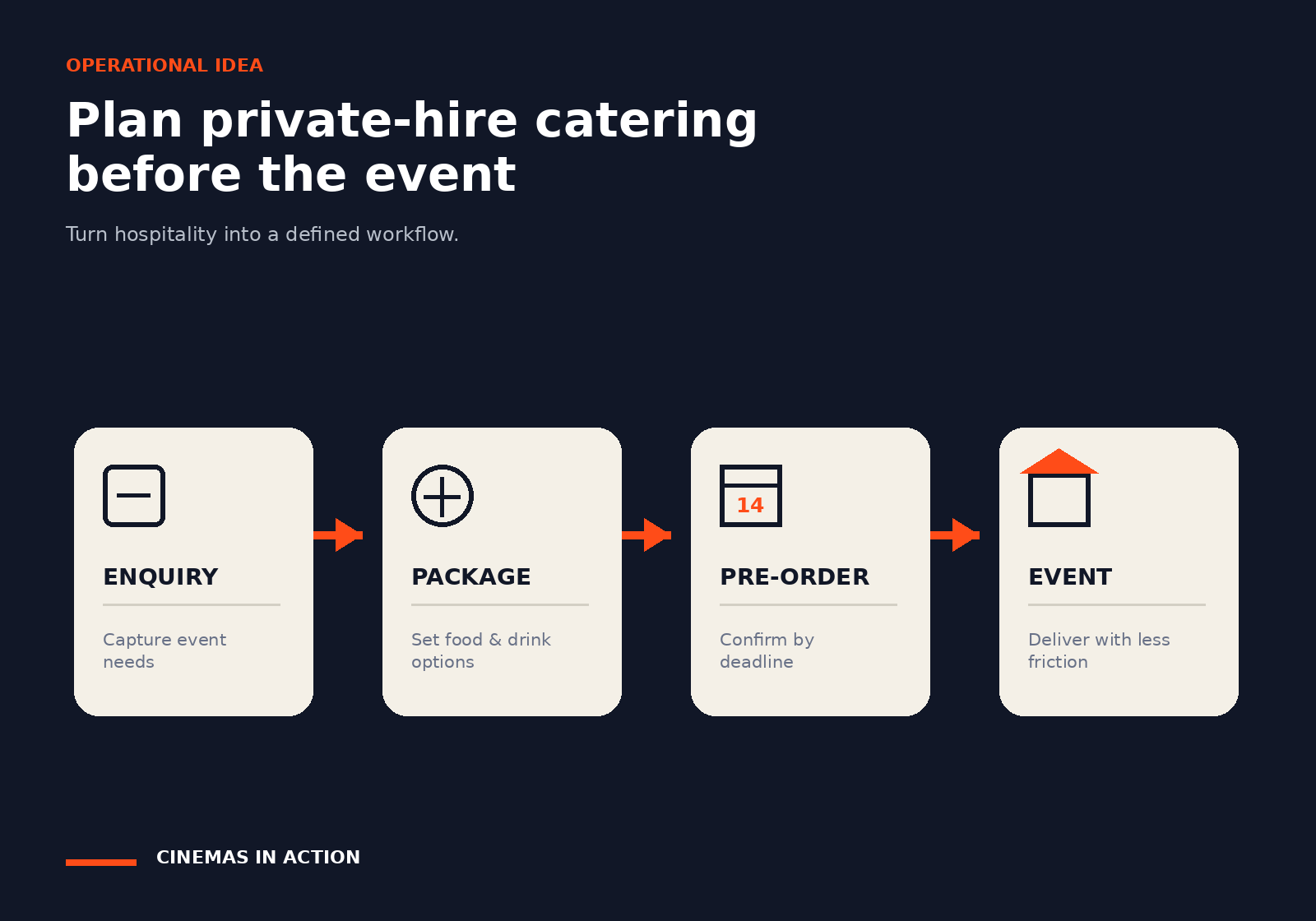
Plan private-hire catering before the event
Everyman requires private-hire food and drink orders through an online link no later than two weeks before the event. The visible mechanism is simple: turn catering into a defined workflow rather than an informal add-on.
Published 3 August 2026
The idea
Treat private-hire catering as a defined operational product with packages, an online order path, a final deadline and clear payment and change rules.
Evidence
Everyman's public FAQ states that private-hire menus vary by booking type and that all food and drink is pre-ordered online no later than two weeks before the event. No conversion or profitability data is published.
Operator takeaway
The adaptable lesson is process discipline. Advance ordering can improve purchasing, preparation, staffing, service timing and client expectations.
Try this
Create three catering packages, an online selection form, dietary fields, minimum numbers, a final-order deadline and explicit payment, amendment and cancellation terms.
Measure
Track enquiry-to-booking conversion, average hire value, F&B per guest, gross margin, labour hours, wastage, order changes, satisfaction and repeat bookings.
Watch out for
A deadline can reduce flexibility and conversion if packages are unclear. Dietary information, allergens, payment, late changes and minimum spend must be handled consistently.
What they are doing
Everyman’s private-hire FAQ says customers receive menus suited to their booking type and place all food and drink orders through an online link no later than two weeks before the event. The public offer covers corporate events, parties, weddings and screenings across its venue network.
Why it caught our attention
The useful lesson is operational rather than promotional. Private hire is treated as a hospitality product with a defined preparation window, not simply an auditorium booking to which refreshments are added at the last minute.
How it works
The client chooses from relevant menus, submits the order online and confirms requirements before a fixed deadline. That gives the venue time to plan stock, suppliers, staffing, preparation, service sequence, dietary requirements and payment before the event date.
What another cinema might adapt
A smaller cinema could create three fixed packages: simple cinema snacks, reception food and a fuller corporate option. Use one online form for guest numbers, selections, timings, dietary needs and invoicing. Set minimum numbers and a clear final-order and amendment deadline.
Questions to consider
Which packages can be delivered reliably? What minimum spend protects labour and waste? When is payment taken? How are allergens recorded and checked? What changes are allowed after the deadline? Can the catering workflow connect to the main booking record and event schedule?
What could be measured
Track enquiry-to-booking conversion, package mix, average hire value, food and drink per guest, gross margin, labour hours, wastage, late changes, service errors, satisfaction and repeat corporate bookings. Compare packaged events with bespoke events.
What is currently known
The official FAQ confirms booking-specific menus, online pre-ordering and a deadline no later than two weeks before the event. Venue pages also present catering as part of the private-hire proposition rather than an incidental extra.
What has not yet been reported
No public information was found on package pricing, order conversion, average spend, margin, labour saving, wastage reduction, satisfaction or repeat bookings. The workflow is observable, but its commercial performance is not.
Sources
Primary sources
- Private Hire FAQs — Everyman Cinemas (opens in a new tab)
Reviewed by CIA 27 July 2026
- Private cinema and venue hire — Everyman Cinemas (opens in a new tab)
Reviewed by CIA 27 July 2026
Explore related topics
- Challenge: Improve F&B spend
- Challenge: Operations and capacity
- Challenge: Venue use
- Audience: Corporate clients
- Audience: Private hire customers
- Theme: Food & beverage
- Theme: Operations
- Theme: Venue hire
More related ideas
Stay updated
Get new Cinemas in Action briefings by email.
New ideas you could test, with the evidence behind them. Occasional operator briefings and new case studies — no marketing, no third parties.