Turn audience research into a practical case for support
Art House Convergence’s 2026 survey provides national evidence about how participating audiences value independent cinemas. The practical opportunity is to combine those benchmarks with local data for sponsorship, funding, membership and stakeholder conversations.
Published 3 August 2026
The idea
Use national audience benchmarks as a starting point, then collect local evidence that can support sponsorship, funding, membership, property and local-authority conversations.
Evidence
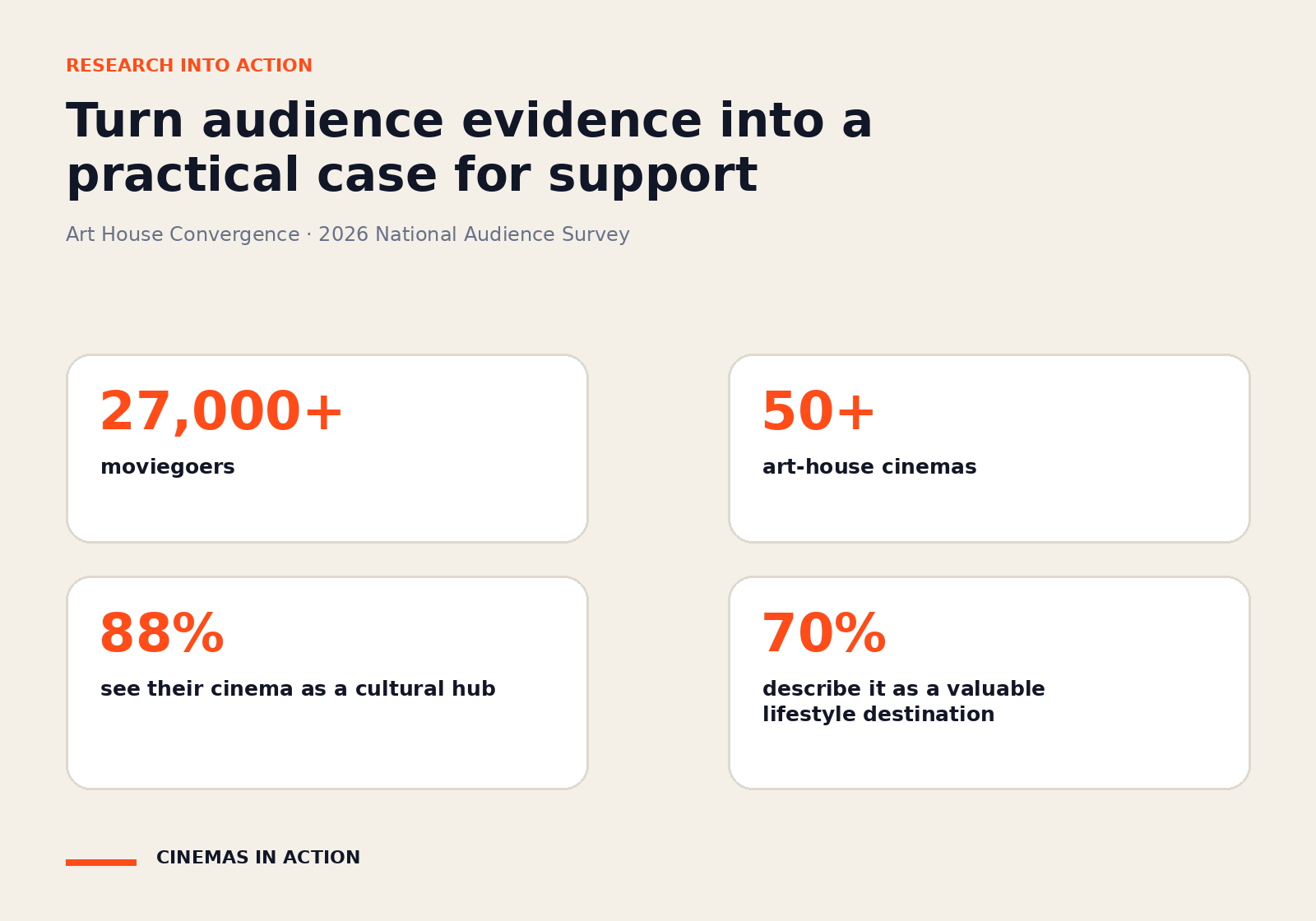
The AHC survey reports responses from more than 27,000 U.S. moviegoers connected with more than 50 art-house cinemas. The sample represents participating audiences, not the general population.
Operator takeaway
A headline statistic becomes more useful when paired with local postcode reach, attendance, partner activity, customer motivations and evidence of community value.
Try this
Run a short local pulse survey using a small set of comparable questions, segment recent and long-term attendees, and combine the findings with operational and community data.
Measure
Track response profile, discovery source, visit motivations, community-value ratings, membership propensity, local spend, partner interest and conversion from the resulting evidence pack.
Watch out for
Do not present engaged audience respondents as representative of every local resident, lapsed customer or non-attender. State the sample, method and limits clearly.
What they are doing
Art House Convergence surveyed more than 27,000 U.S. moviegoers connected with over 50 art-house cinemas. The published findings cover cinema value, community connection, membership motivations, programming preferences, repertory interest and the characteristics of more recent attendees.
Why it caught our attention
The figures can do more than support positive publicity. They provide language and benchmarks that cinemas can use in sponsorship, donor, landlord, regeneration, funding and local-authority conversations—provided the national data is paired with evidence from the cinema’s own audience and catchment.
How it works
The national survey supplies common questions and a wider reference point. A local cinema can repeat a smaller set of questions, compare recent and established attendees, and combine the responses with admissions, postcode reach, school activity, employment, local purchasing, partner testimonials and customer stories.
What another cinema might adapt
Create a short evidence pack with three layers: national context, local audience findings and operational/community facts. Keep the local survey brief enough to complete, use consistent answer scales and ask where respondents discovered the cinema, why they attend, what would increase attendance and how they value the venue locally.
Questions to consider
Who answered the survey and who did not? Are respondents members or frequent users? Can results be segmented by age, recency, postcode and visit frequency? Which stakeholder decision should the evidence influence? What local data is needed to avoid relying on sentiment alone?
What could be measured
Measure response rate, respondent profile, recent-attendee share, discovery source, motivations, desired programming, perceived community value, membership interest and local spend. Then track whether the evidence pack contributes to sponsor leads, donor conversion, funding applications, memberships or stakeholder meetings.
What is currently known
AHC reports more than 27,000 respondents from more than 50 cinemas. Among respondents, 88% agreed their preferred cinema is a cultural hub of the community, while more than 70% said it was very or extremely valuable to their quality of life.
What has not yet been reported
The headline figures do not describe every local market. They do not represent non-attenders, and cinema-level variation is not visible in the press release. Any local use should retain the survey’s scope and avoid treating audience affection as proof of incremental attendance or financial sustainability.
Sources
Primary sources
- 2026 National Audience Survey press release — Art House Convergence (opens in a new tab)
Source dated 22 June 2026 · Reviewed by CIA 27 July 2026
- Reports and Data — 2026 National Audience Survey — Art House Convergence (opens in a new tab)
Reviewed by CIA 27 July 2026
Explore related topics
- Challenge: Grow membership
- Challenge: Measurement and evidence
- Challenge: Partnerships and sponsorship
- Audience: Art house audiences
- Audience: Local communities
- Audience: Members
- Theme: Community
- Theme: Evidence and measurement
- Theme: Membership & loyalty
More related ideas
Stay updated
Get new Cinemas in Action briefings by email.
New ideas you could test, with the evidence behind them. Occasional operator briefings and new case studies — no marketing, no third parties.