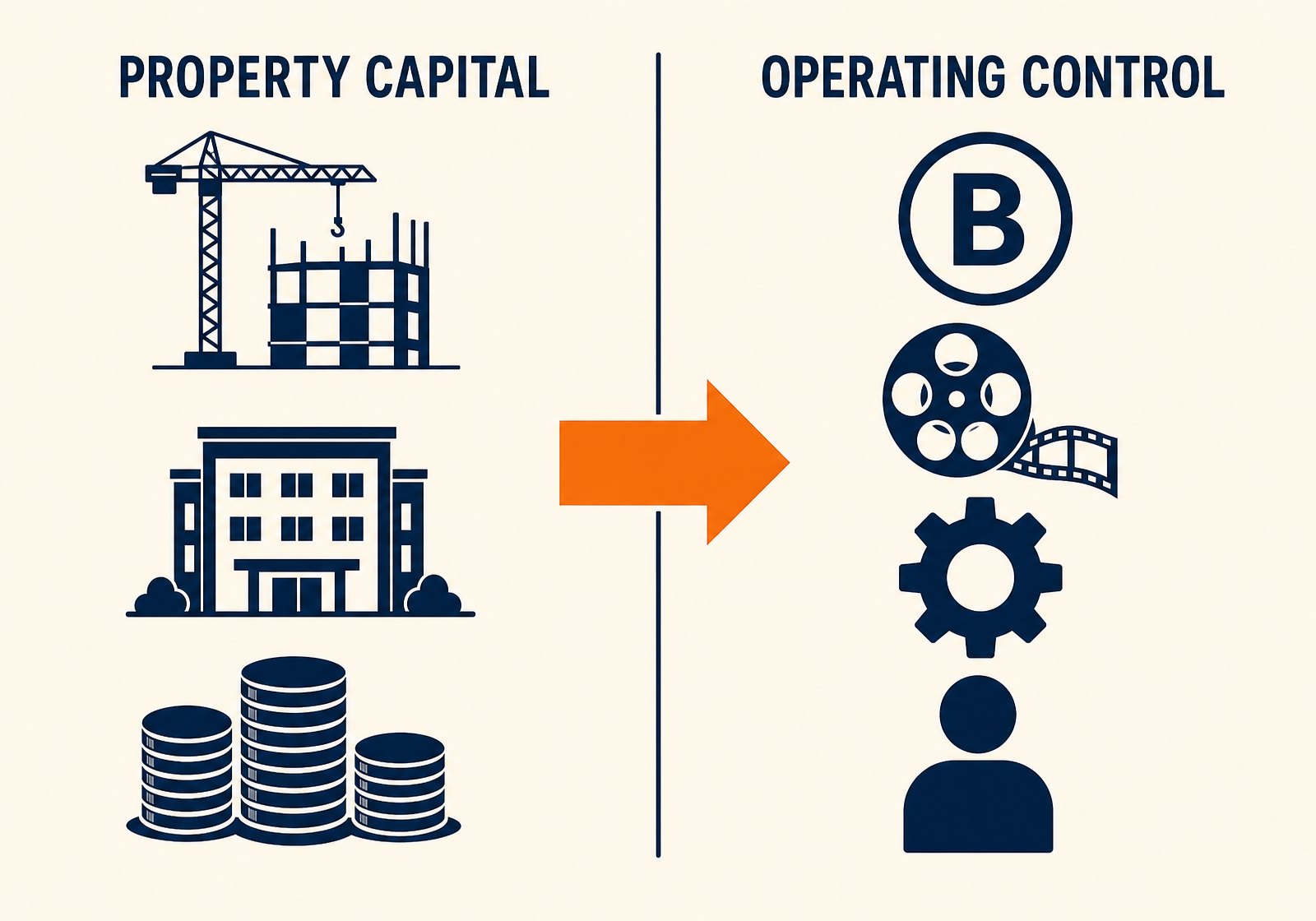
Separate property capital from cinema operating control
PVR INOX's SMART Cinema model for smaller Indian cities uses a franchise-owned, company-operated structure: local partners fund or own the property while the operator keeps brand, programming and operating control.
Published 10 August 2026
The idea
Split the question of who funds the building from the question of who runs the cinema, and keep operating control without financing the whole property asset.
Evidence
Observed example. The model and an initial rollout were announced on 4 August 2026; no public operating results exist yet.
Operator takeaway
Expansion structure is a commercial design decision, not only a property decision. Ownership and control can be separated deliberately.
Try this
Before the next site decision, model the same location as an owned property, a lease, a management contract, a franchise and a FOCO arrangement.
Measure
Capital per screen, property-partner return, admissions ramp, average ticket price, F&B spend, EBITDA per screen and capital payback.
Watch out for
Brand and service standards are harder to hold when the capital sits with a third party; compliance obligations need to be explicit in the agreement.
What they are doing
PVR INOX announced its SMART Cinema proposition on 4 August 2026 for Tier III Indian cities. The reported structure is primarily FOCO — franchise-owned, company-operated — with the first site planned for Muzaffarpur and agreements reportedly signed for six further locations over the following nine months. The proposition includes modern auditoriums, 2K laser projection, 7.1 sound, curated food and beverage and a more value-oriented format.
Why it caught our attention
The transferable idea is not expansion into smaller towns. It is the structural question underneath it: which parts of a cinema business need to be owned, and which only need to be controlled?
How the mechanism works
A local developer or entrepreneur funds or owns the property. The exhibitor contributes brand, programming, customer experience, operating standards, technology, food and beverage and marketing, and operates the site under an agreement that defines standards and returns.
What another cinema might adapt
Compare alternative expansion structures for the same opportunity: owned property, long lease, management contract, franchise, FOCO and joint venture. The comparison is more useful when it is run on one real site rather than in the abstract.
Questions to consider
Which standards would you be unwilling to delegate? What happens if a property partner wants to exit? Who carries the cost of a refurbishment cycle, and who benefits from the uplift afterwards?
What could be measured
Capital per screen, property-partner return, admissions ramp, average ticket price, food and beverage spend, staffing cost, EBITDA per screen, capital payback, management fee and brand compliance.
What is currently known
The model and the initial rollout have been announced by the operator and reported in the trade and business press.
What has not yet been reported
No public operating results exist. SMART Cinemas should not be described as proven or financially successful.
Sources
Primary sources
- PVR INOX corporate website — PVR INOX (opens in a new tab)
Reviewed by CIA 10 August 2026
Supporting sources
- PVR INOX SMART Cinemas announcement reporting — The Economic Times (opens in a new tab)
Source dated 4 August 2026 · Reviewed by CIA 10 August 2026
Explore related topics
- Challenge: Operations and capacity
- Challenge: Venue use
- Audience: First-time visitors
- Audience: General audience
- Theme: Operations
- Theme: Partnerships
More related ideas
Stay updated
Get new Cinemas in Action briefings by email.
New ideas you could test, with the evidence behind them. Occasional operator briefings and new case studies — no marketing, no third parties.